Images presented here may not fully represent the product
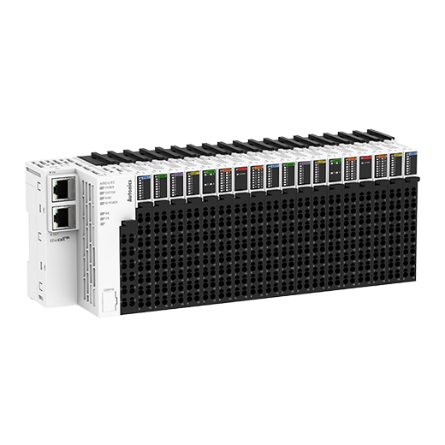
The ARIO series supports eight communication protocols. Versions are available for EtherCAT, CC-Link V1/V2, ProfiNet, ProfiBus, EtherNet/IP, DeviceNet, Modbus TCP and Modbus RTU, among others. Various types of I/O modules, including digital, analogue, temperature and power modules, allow the system to be freely configured and expanded. The hot-swap function allows the terminal and control unit to be removed during operation without disconnecting communication or power. This speeds up maintenance and reduces downtime.
The push-in wiring method facilitates installation and requires no additional tools. The modules can be easily installed on a DIN rail, and the dedicated DAQMaster software allows for module configuration, input and output signal preview, diagnostics, and virtual mode configuration simulation.
• Ethernet/Fieldbus communication for Smart Factory automation
• Distributed input and output control via PLCs and industrial computers
• 8 supported communication protocols: EtherCAT, CC-Link V1/V2, ProfiNet, ProfiBus, EtherNet/IP, DeviceNet, Modbus TCP, Modbus RTU
• Digital, analogue, temperature and power supply modules available
• System expansion up to 64 modules (depending on protocol)
• Hot-swap function allowing modules to be replaced without stopping the system
• Push-in connectors for quick connection of cables without tools
• Easy installation and removal on DIN rail
• DAQMaster software for signal configuration, monitoring and diagnostics
• Virtual mode for simulating settings and optimising configuration
Address:
ELTRON Spółka z ograniczoną
odpowiedzialnością Sp. k.
ul. Brodzka 10B
54-103 Wrocław
Customer Service:
Telefon: +48 71 343 97 55
E-mail: kontakt@eltron.pl
Find us elsewhere: