Images presented here may not fully represent the product
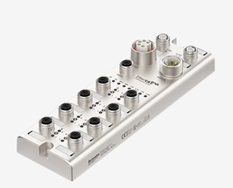
The ADIO series from Autonics consists of advanced remote input/output (Remote I/O) modules that enable reliable signal transmission between master devices, such as PLC controllers and industrial PCs, and slave devices, including sensors and actuators. The ADIO system supports modern communication in industrial automation applications, enabling the integration of input and output signals within distributed control systems.
The series offers two types of modules: IO-Link Master (ADIO-ILM) and IO-Link HUB (ADIO-HUB).
The ADIO-ILM (IO-Link Master) module enables communication with both IO-Link and standard I/O slave devices, converting data to popular industrial network protocols: EtherCAT, EtherNet/IP and PROFINET. The ADIO-HUB, on the other hand, extends the number of supported I/O ports by connecting to the IO-Link Master unit and transmits data based on IO-Link communication.
With their rugged design and IP67/IP69K protection rating, ADIO modules are ideal for demanding industrial environments, offering high resistance to dust, moisture and external factors. The system allows for port configuration, monitoring of input/output status (short circuits, open circuits, communication status), as well as support for daisy chain connections, which facilitates installation expansion and reduces the amount of cabling.
Housing and durability
System functions
IO-Link Master module (ADIO-ILM)
IO-Link HUB module (ADIO-HUB)
Address:
ELTRON Spółka z ograniczoną
odpowiedzialnością Sp. k.
ul. Brodzka 10B
54-103 Wrocław
Customer Service:
Telefon: +48 71 343 97 55
E-mail: kontakt@eltron.pl
Find us elsewhere: