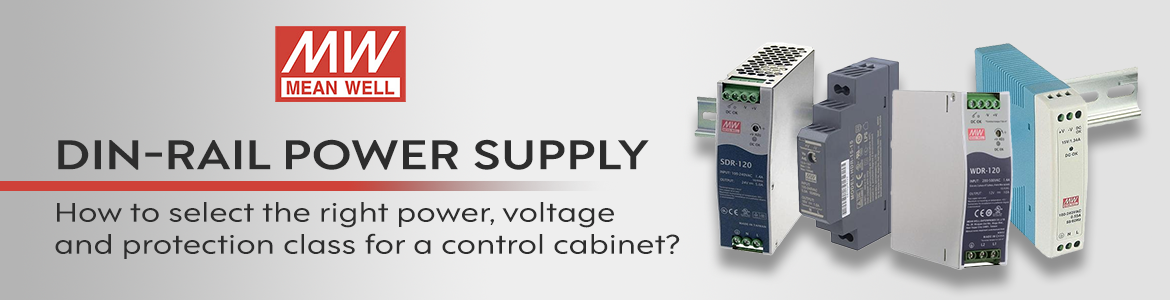
In this article, we explain how to select a DIN rail power supply for real operating conditions. We discuss power sizing, voltage requirements and key protection functions. We also explain why Mean Well DIN rail power supplies are a reliable choice for control cabinets where stable voltage, sufficient power reserve and protection matched to industrial loads are essential.
What role does a DIN rail power supply play in a control cabinet?
A DIN rail power supply in a control cabinet converts AC mains voltage into a stable DC output voltage – most often 24 V – used to power PLCs, sensors, relays, HMI panels, communication modules, signal converters and safety devices.
In practice, the quality of a power supply is not determined only by whether it works correctly during start-up. What matters more is how it behaves under load. If the output voltage drops or the device operates above its rated power, the effects can be seen in the entire system: intermittent PLC errors, unstable sensor signals, communication problems or machine stoppages without an obvious cause.
The mounting format itself is also important. DIN rail design makes it easier to organize the control cabinet in practice – the power supply can be installed directly next to circuit breakers, terminals and controllers. This simplifies cabinet layout, while later servicing or system expansion becomes much more convenient.
How to calculate the required power of a DIN rail power supply?
To calculate the required power of a DIN rail power supply, add up the current demand of all devices in the cabinet and then include a realistic power reserve based on the conditions in which the power supply will operate. The goal is not to choose a device that only looks good “on paper”, but one that can handle all connected loads during normal operation.
Step 1: Add up the current of all connected devices
List every device powered from the DC output and check its rated current in the datasheet or on the nameplate. Include obvious loads, but do not overlook smaller components such as signal converters, safety modules or indicator lights – these are often what determine whether the power supply can handle the total load.
Formula: required power [W] = output voltage [V] × total load current [A]
Example: if all connected devices draw a total of 5 A from a 24 V DC power supply, the required power is 120 W.
Step 2: Add a safety margin for real operating conditions
Load data alone does not show the full picture. Inrush currents, ambient temperature, voltage drops and planned system expansion all reduce the available margin. In most control cabinets, a reasonable starting point is a reserve of 20–30% above the calculated continuous load.
For a required power of, for example, 120 W, add a 25% reserve: 120 W × 1.25 = 150 W. This means that a power supply with a rated output of 150 W is the minimum reasonable choice.
In hot or poorly ventilated enclosures, it is worth increasing the reserve even up to 50%. In practice, temperature is one of the most common factors limiting the real usable power of a power supply. Check the derating curve in the datasheet – it shows whether the rated output power can be maintained at the temperatures the cabinet may reach.
Which output voltage should you choose: 12 V DC, 24 V DC or another value?
Choose the output voltage required by the devices connected to the power supply. In industrial automation cabinets, 24 V DC is the most common choice, but specific loads may require 12 V DC, 48 V DC or another voltage.
The table below shows the most common solutions:
| Output voltage / solution | Typical use in a control cabinet |
|---|---|
| 24 V DC | Standard choice for PLCs, sensors, I/O modules, relays, safety devices, HMI panels and industrial communication components. |
| 12 V DC | Used in selected electronic modules, access control devices, small auxiliary systems and some LED-related circuits. |
| 48 V DC | Used in telecommunications, PoE-related systems, battery backup applications and selected power or drive subsystems. |
| Additional DC/DC converter | Useful when one cabinet contains devices with different voltage requirements, for example a main 24 V DC power supply and a local 12 V DC subsystem. |
To compensate for voltage drops on long cables, many DIN rail power supplies offer potentiometer adjustment. This allows you to set the exact output voltage required by the installation.
Which protection functions are important in a DIN rail power supply?
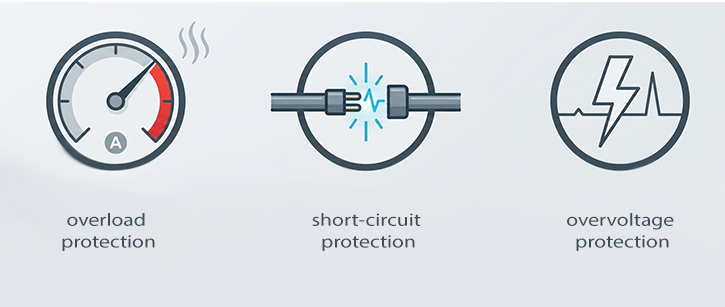
The way a DIN rail power supply reacts to abnormal operating conditions is mainly determined by three protection functions: overload protection, short-circuit protection and overvoltage protection. Together, they influence whether a fault results in a short interruption or serious damage – and how safely the cabinet can be restarted.
Overload protection
Cabinet expansion, current peaks during start-up or a device beginning to fail may cause the load to exceed the rated power of the power supply. Overload protection reduces the risk of overheating, voltage drops and component damage. As a result, a manageable situation is less likely to turn into a costly failure.
Short-circuit protection
A short circuit in a control cabinet may result from wiring errors, damaged insulation, a loose terminal or a faulty device. Short-circuit protection allows the power supply to respond safely, without turning a local problem into a failure of the entire cabinet – and without making diagnostics unnecessarily difficult.
Overvoltage protection
Overvoltage protection reduces the risk of excessive output voltage reaching sensitive loads. This is important because PLCs, sensors, communication modules and measuring devices may be damaged if the voltage exceeds their permitted input range. In practice, this function helps protect the control system when the power supply or a connected circuit starts to operate incorrectly.
What protection class and IP rating should a control cabinet power supply have?
Selecting the protection class and IP rating starts with one key distinction: in most installations, the cabinet provides the main protection against the external environment. The enclosure IP rating defines resistance to dust, water and accidental contact – and it is this rating that is decisive, not the IP rating of the power supply itself.
However, sealed enclosures have their limitations. An IP65 cabinet effectively protects against dust and water, but at the same time traps heat inside. Even a well-protected installation requires proper airflow, suitable mounting clearances and a power supply designed for the expected operating temperature.
The protection class refers to a different area. It concerns electrical safety, not environmental conditions. Before making the final selection, check whether the model requires a protective earth connection, what wiring requirements it has and whether its safety certifications match the specific application.
For industrial applications, Mean Well offers a wide range of DIN rail power supplies for control cabinets, including models with the protection functions and certifications needed in most typical applications.
The role of temperature and ventilation when selecting a power supply
The temperature inside the cabinet directly affects how much power a DIN rail power supply can deliver continuously. In hot or poorly ventilated enclosures, it may be necessary to reduce the rated power, known as derating. This means that the power supply should not operate at full power, even if its nominal parameters suggest that it can.
Before choosing a specific model, check the datasheet for the operating temperature range, derating curve, required mounting clearances and recommended mounting orientation. For sealed or densely packed cabinets, choose a power supply with an appropriate power reserve and make sure heat can be removed from the enclosure.
Why choose Mean Well DIN rail power supplies for control cabinets?
Thanks to a catalogue covering thousands of products, certifications such as TÜV, UL, CSA and S MARK, and a production process based on ISO 9001, Mean Well is a common choice for control cabinet applications. Engineers benefit from a wide selection of models, straightforward replacement options and confidence that the right product will also be available when the cabinet needs to be modified in the future.
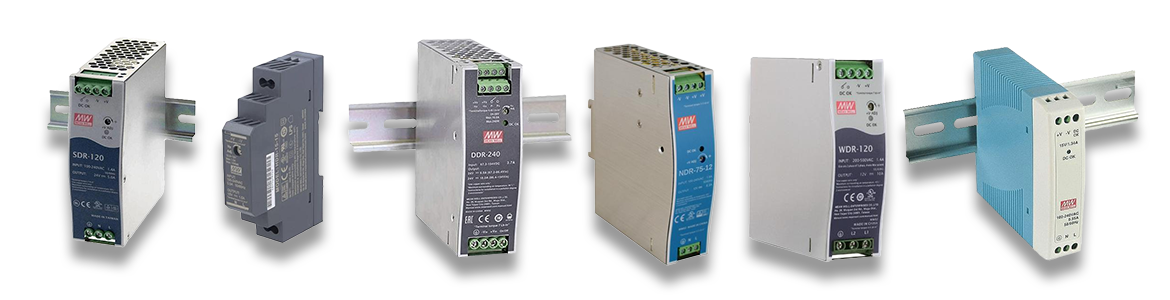
Mean Well offers several DIN rail power supply series, each designed for different needs:
- HDR series – slim design for cabinets where mounting space is limited.
- MDR series – economical and compact design; suitable for less demanding applications.
- SDR series – standard industrial design with good thermal performance, intended for continuous operation.
- DDR series – models with DC input for battery backup systems or systems powered from a DC bus.
- NDR series – higher power density for demanding loads in standard cabinet installations.
- WDR series – wide AC input range for cabinets where mains voltage is unstable or variable.
Common mistakes when choosing a DIN rail power supply
The most common mistakes result from selecting a power supply only on the basis of output voltage and rated power. In practice, the model must also be matched to real operating conditions in the cabinet, such as start-up behavior or cable length.
Typical mistakes include:
- Ignoring the total load current may lead to choosing a power supply with insufficient capacity, resulting in voltage drops, unstable device operation or overload shutdowns when all receivers in the cabinet operate at the same time.
- No power reserve makes the cabinet vulnerable to inrush peaks, later expansion and temporary overloads, even if the power supply initially appears to be correctly sized.
- Not accounting for voltage drop may cause sensors, relays or remote modules to receive lower voltage than required. This problem becomes more pronounced with long DC lines or insufficient cable cross-section.
- Ignoring derating may lead to overheating of the power supply or loss of part of the output power in a hot, sealed or densely packed cabinet.
- Choosing only by price may mean missing protection functions, lower efficiency, unsuitable safety certifications or poor documentation for maintenance teams.
- Replacing a failed power supply without identifying the cause of failure may lead to the same problem recurring if the original cause was overload, high temperature, poor ventilation or a wiring error.
Find the right Mean Well DIN rail power supply at ELTRON
ELTRON has been offering Mean Well products for more than 12 years, supporting customers in selecting power supplies for control cabinets and industrial installations. Check the range of Mean Well DIN rail power supplies available at ELTRON.
The ELTRON offer includes, among others:
- Mean Well DIN rail power supplies for control cabinets,
- 12 V DC, 24 V DC, 48 V DC models and other voltage variants,
- HDR, MDR, SDR, DDR, NDR and WDR series,
- solutions for industrial automation, control systems and OEM installations.
Not sure which model will be suitable for your installation? Contact our sales department – our experts will help you choose the right solution.