Images presented here may not fully represent the product
ELTRON – Your partner in automation, electronics and industrial electrical engineering
For over three decades, ELTRON has been supporting the development of Polish industry by providing proven and reliable solutions in the fields of automation, electronics and electrical engineering. ELTRON is not just a distributor of components, but above all a team of experienced engineers and technical advisors who support customers at every stage of implementation – from selecting solutions, through implementation, to the operation of highly reliable industrial ecosystems.
One of the key manufacturers in the ELTRON portfolio is Mersen (formerly Ferraz Shawmut) – a well-established brand and leading producer of components and solutions for electrical safety, including fast fuses for AC and DC voltages, industrial fuses for NH and 10x38 standards, fuse bases and surge arresters. Mersen also specialises in graphite components, carbon brushes for electric motors and active cooling solutions. For over 25 years, ELTRON has served as the authorised official distributor of Mersen (formerly Ferraz Shawmut) products on the Polish market, combining access to the full product range with application expertise and professional technical support.
How to read fuse characteristics: gG, aM, aR – and why gF is becoming history
The two letters printed on the ceramic body of a fuse link (e.g. gG, aM, aR) encode information about the element geometry, its Joule integral (I²t) capacity and the current range within which the fuse will operate at all. Substituting one class for another without analysing these parameters may result in destruction of the protected circuit or, in extreme cases, fire.
Where does the NH standard come from? A brief history of the fuse body
First, a few words about the fuse body itself – its history explains why European electrical engineering looks different from its American or British counterparts.
NH stands for Niederspannungs-Hochleistungs-Sicherung (German: low-voltage high-breaking-capacity fuse). The first NH high-power fuse designs were introduced in Germany around 1926, pioneered by Siemens and AEG. By the 1930s the NH standard had been formally codified in DIN 43620.
The direct reason for developing NH fuses was the limitations of the screw-type systems of the time. Diazed fuses (Differenzierte Ausführung, German: differentiated design), which dominated European installations from the turn of the 19th and 20th centuries, were physically unable to extinguish arcs at short-circuit currents of tens of kiloamperes. The ceramic body of Diazed fuses could not withstand the plasma pressure, and the relatively small amount of quartz sand filler was unable to produce sufficient fulgurite (sand fused by the electric arc) to interrupt the circuit.
The expanding heavy industry and early urban power networks demanded a new format – one with higher breaking capacity and repeatable I²t characteristics. This is how the NH blade-type fuse was born.
By the late 1930s, blade fuses had become the industrial standard in Germany, and by the early 1950s they had spread across Western Europe.
Three worlds that are not mechanically interchangeable
The United Kingdom retained the BS 88 (HRC – High Rupturing Capacity) standard, while the United States adopted UL 248, which defines construction classes such as:
The blade contact dimensions, body lengths and cross-sections differ across all three systems – mechanical interchangeability does not exist.
Polish electrical engineering – why the NH standard?
The context in Poland was complex due to the period of partition. The Warsaw Powiśle Power Plant, opened in 1903 – one of the first large urban power stations in the region – supplied trams and street lighting based on its own infrastructure.
The Prussian partition applied German standards directly; the Austrian partition used partly its own, partly Viennese norms. After regaining independence in 1918 and establishing SEP (the Association of Polish Electrical Engineers), Polish electrical engineering faced the task of harmonising three different installation systems within a single country.
In practice, German standards prevailed – due to the high degree of industrialisation in the recovered regions of Greater Poland and Silesia, formerly under Prussian rule, where infrastructure was based primarily on German VDE standards. After 1945, industrial reconstruction proceeded on the existing infrastructure – and the NH standard remained the universal standard throughout Poland.
The first letter: protection range
This is a classification that must never be violated when selecting a fuse for an application.
g (ganzbereich – full range)
The fuse interrupts any current – from minimum overload up to the rated breaking capacity.
a (Abschneidebereich – current-limiting range)
Interrupts short-circuit currents only – typically from ≥ 4·In upwards.
The second letter: protected object
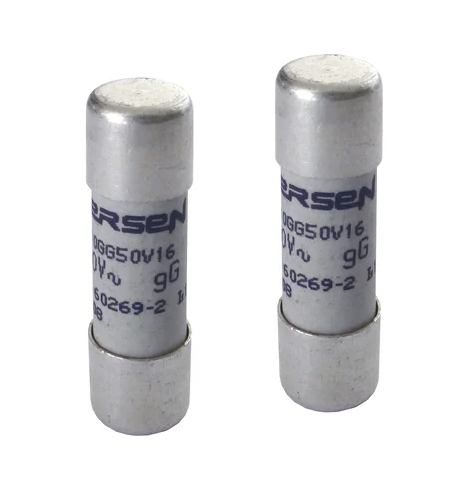
gL / gG – cable and wiring protection
Following harmonisation of IEC 60269, the designation gG (General purpose) was introduced.
A gG fuse protects cable installations and distribution networks.
Applications:
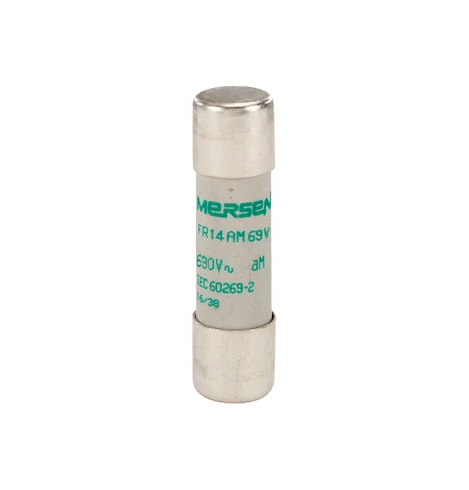
aM – motor protection
A squirrel-cage motor draws a current between 4 and up to 10 times its rated value during start-up.
The aM fuse link has a higher I²t rating and tolerates inrush currents.
Important:
An aM fuse does not provide overload protection – a thermal overload relay is required.
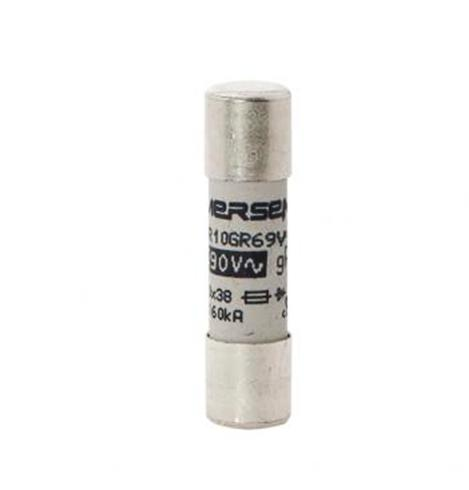
aR / gR – semiconductor protection
Power electronic components (diodes, thyristors, IGBT transistors) have very low thermal capacity.
aR/gR fuses have a very low I²t rating and limit the current before the energy reaches the semiconductor junction.
Using a gG fuse to protect an inverter is a design error.
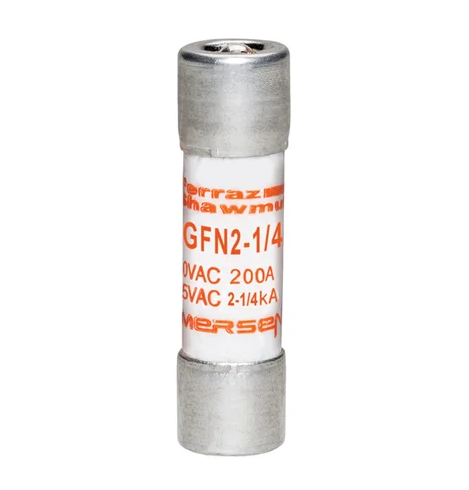
gF – fast characteristic for high-impedance networks
Problem:
In long overhead lines the short-circuit current is too low for a gG fuse to operate within the required time.
Solution:
The gF fuse – a characteristic shifted to the left (faster operation).
Normative status:
IEC 60269 no longer includes this characteristic in its current edition – gF has been withdrawn from European standardisation.
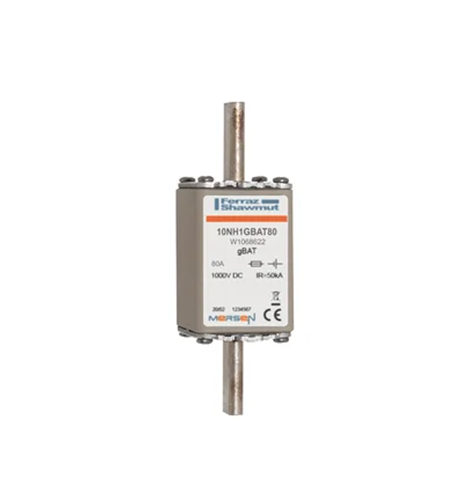
gB – mining environment
gB (Bergbau) fuse links are used in mining networks.
Long cables and high impedance cause short-circuit current attenuation.
A gB fuse coordinates:
Consequences of substituting fuse classes
| Incorrect substitution | Consequence |
|---|---|
| gG instead of aR/gR | destruction of semiconductor modules |
| aM instead of gG | no overload protection |
| gG instead of gF | excessive tripping time |
| gG instead of aM | fuse link failure during motor start-up |
Changing the letter means changing:
Selecting fuse links and finding replacements – the practical side of design
Installations across Poland contain fuse links from many manufacturers – both current and legacy.
Replacement fuses are selected on the basis of:
Matching rated current value and body size alone is not sufficient for a correct like-for-like substitution between manufacturers.
Mersen at ELTRON – over 25 years of experience
ELTRON is an authorised distributor of Mersen in Poland since 1999.
The partnership began under the Ferraz Shawmut brand.
Today, Mersen solutions are used in:
ELTRON supports designers and system integrators with:
NH fuse links available from stock
ELTRON's warehouse in Wrocław holds a comprehensive stock of Mersen NH gG 500 V AC fuse links.
The full size range is available:
NH00C – NH3
This ensures:
We stock the complete range of NH gG 500V AC blade fuse links – from size 00C to NH3 – ready for dispatch within 24 hours of ordering, both within Poland and internationally.
Current availability can be checked at www.eltron.pl or by contacting the ELTRON technical department.

Address:
ELTRON Spółka z ograniczoną
odpowiedzialnością Sp. k.
ul. Brodzka 10B
54-103 Wrocław
Customer Service:
Telefon: +48 71 343 97 55
E-mail: kontakt@eltron.pl
Find us elsewhere: